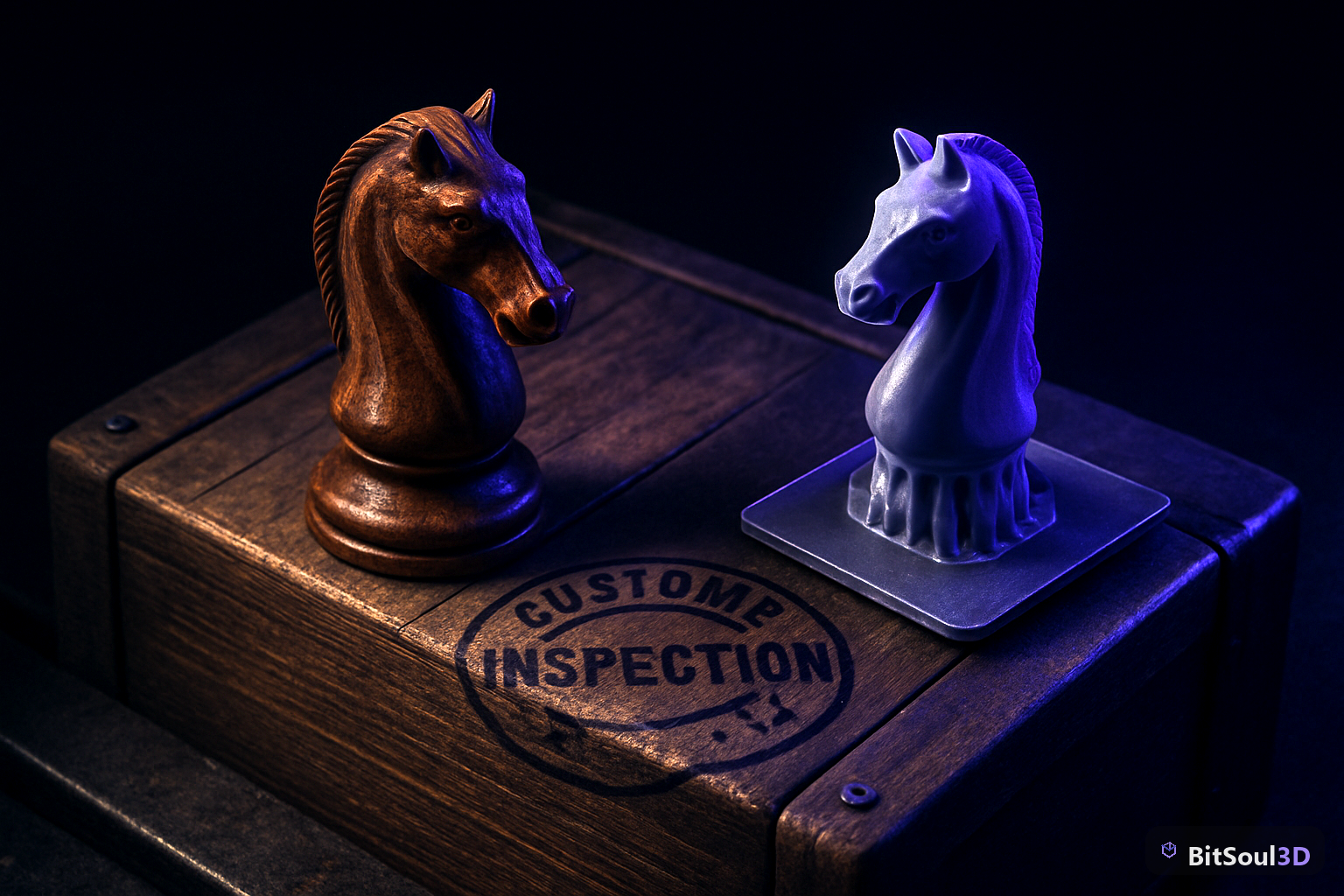
You ran a background prop through an AI text-to-3D tool to hit a deadline, and now you're staring at the Steamworks Content Survey before your store page goes live. Does that one barrel force the AI-disclosure checkbox for your whole game? No — and the answer has nothing to do with who modeled it. Valve's January 16, 2026 rewrite of the Generative AI Content section checks what shipped inside your build, not how much of it you touched by hand. A hand-authored GLB you bought from a marketplace never trips the rule. A prop your AI tool generated does, even if it's one asset out of four hundred.
The numbers behind Steam's one-in-five

Steam now carries a public AI-disclosure label on roughly one in five games released in 2025 — at least 20%, per tracking cited across multiple outlets covering Valve's policy. That's up from about 1,000 disclosed titles in all of 2024 to close to 8,000 by the first half of 2025, an eightfold jump in eighteen months. Zoom out and the share looks smaller: only around 7% of Steam's entire back catalog carries the label, because most of what's on Steam shipped before generative tools were common in production pipelines. Steam controls an estimated 74–75% of PC digital distribution by revenue against roughly 3% for the Epic Games Store, which is what turns Valve's internal content rule into the closest thing the industry has to an actual AI-disclosure law, with no regulator involved.
Epic's own storefront requires nothing comparable. Neither do the PlayStation Store, Xbox, or the Nintendo eShop. Google Play limits disclosure to a narrow set of "sensitive" categories, and Apple's App Store has no equivalent requirement at all. The inconsistency gets stranger inside Epic's own house: Sketchfab, which Epic owns, has required a mandatory "CreatedWithAI" label on every generative-AI model since December 11, 2025 — the same company running a no-disclosure game store and a mandatory-disclosure asset store at once.
This isn't the first AI-content line game developers have had to navigate this year. GMTK's July 2026 jam rules split hairs over what still counted as legal when a submission leaned on generative art, and Godot's editor team drew its own boundary by banning AI-written code contributions to the engine itself. Steam's rule is the one with real teeth, because it's attached to a store listing people pay for.
How the pre-generated vs. live-generated test works
Valve splits the Generative AI Content section of the Content Survey into two buckets, first reported by PC Gamer and confirmed by Game Developer. Pre-generated content is anything made during development that ships inside the finished game or its store page: character art, textures, voice lines, dialogue text, and marketing material like key art or trailer thumbnails. It has to be described in the public About This Game section. Live-generated content is created while the game is actually running — dynamic NPC dialogue, a procedurally voiced character reacting to a player in real time — and requires a written description of the guardrails stopping it from crossing lines Valve won't allow. One category gets zero exceptions: live AI-generated Adults-Only sexual content is barred outright.
The exemption most solo devs misread is the one for internal workflow tools. Valve carved out AI coding assistants and engine efficiency tools used only behind the scenes, so a team debugging a build or scripting inventory logic with an AI assistant discloses nothing. That carve-out stops at the tool's output, not its use. Valve's own category list names art, audio, dialogue, and code — it doesn't call out 3D meshes by name, but a GLB that ships in your build is visual art by any reasonable reading of "content a player actually sees," which is the phrase Valve uses to describe what the rule is actually checking.
| Storefront | Requires AI disclosure | What triggers it |
|---|---|---|
| Steam | Yes | Pre-generated art, audio, dialogue, or code that ships, or live-generated content, described in the Content Survey |
| Sketchfab (Epic-owned) | Yes | Any model tagged as made with generative AI, since Dec 11, 2025 |
| Google Play | Partial | Narrow "sensitive" categories only, like realistic AI-generated people |
| Epic Games Store | No | No content survey of any kind |
| PlayStation / Xbox / Nintendo eShop | No | No public policy identified |
| Apple App Store | No | No AI-content requirement identified |
Four gotchas that catch solo devs off guard

- Marketplace source matters, and not every listing tells you. If a product page doesn't state how a model was made, don't assume "handmade." BitSoul3D's 747-model catalog, including pieces like Character Corrupted AI Avatar, is modeled and textured by hand, so swapping one in for a generated placeholder doesn't add a line to your Content Survey. A free account's two monthly downloads cover evaluation; commercial use is included with paid memberships (pricing).
- Hand-finishing doesn't erase origin. The test runs on what generated the content that ships, not who last opened the file. A prop that started as a Tripo or Meshy output and got retopologized and hand-painted afterward is still, under Valve's "ships inside the game" framing, content that began as AI generation.
- Marketing assets count on their own. An AI-generated key art banner or trailer thumbnail can trigger disclosure even when every in-game asset is fully hand-modeled, because the pre-generated bucket explicitly covers marketing and store-page material, not just gameplay content.
- The workflow-tool exemption is narrower than it sounds. It covers things like AI coding assistants and engine efficiency tools used behind the scenes, not asset-generation tools whose output ends up in the shipped build. Using an AI assistant to write your inventory system is exempt. Using one to generate the inventory icons is not.
Before you fill out the Content Survey, pull the list of every asset in your build's content directory and sort it by source: hand-modeled, marketplace-purchased, or generated. Anything in the third pile gets a line in the About This Game section. The shipped mesh doesn't care whether someone spent an afternoon retopologizing it afterward, because Valve's test runs on origin, not on the last person who touched the file.
---
*This post is part of the Ultimate Guide to Free 3D Game Assets — BitSoul's complete reference for formats, texturing, rigging, optimization, and engine integration.*