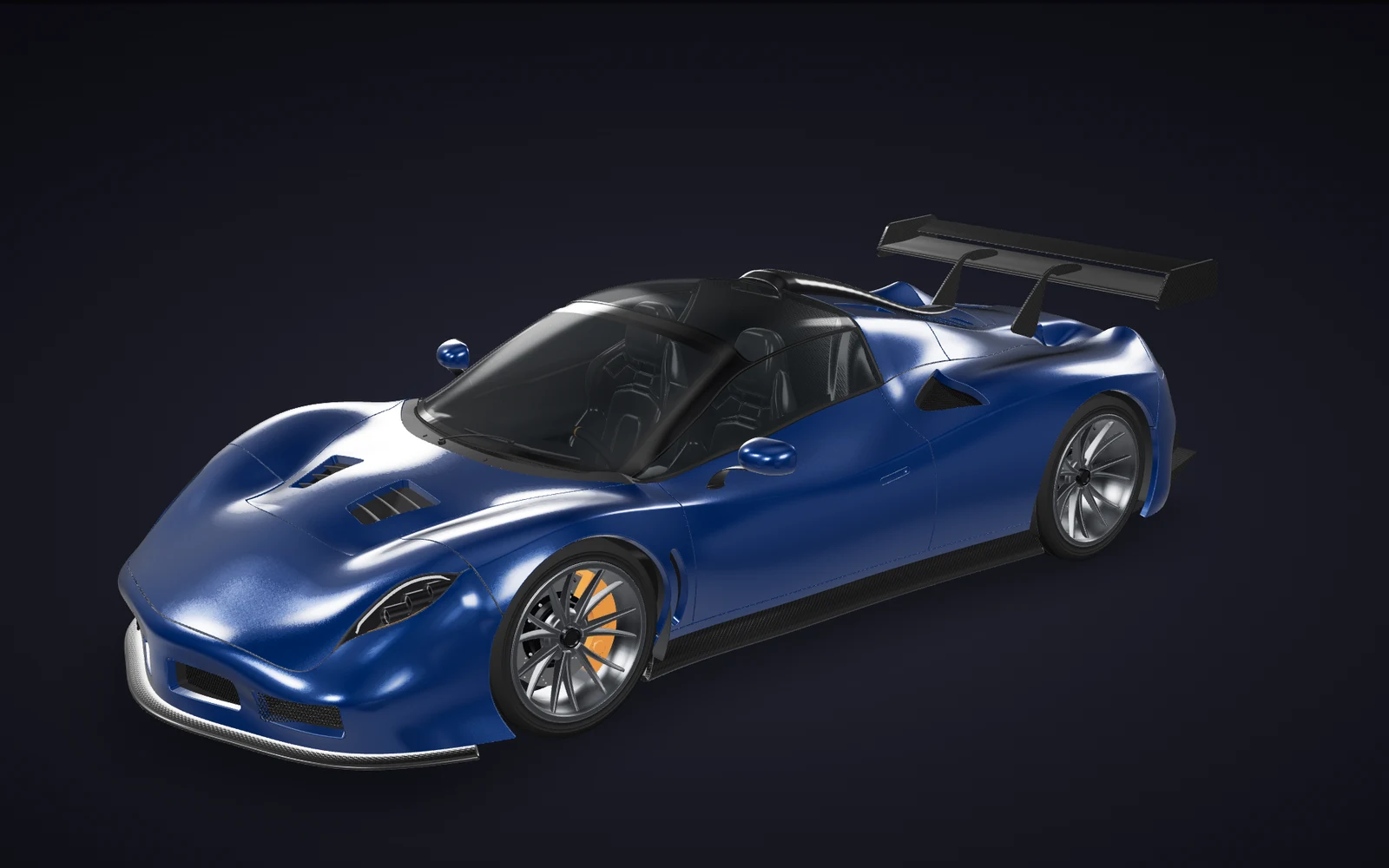
The 3D view is the full-detail model — 139 MB, nothing simplified. On a phone, load it on Wi-Fi; the gallery and close-ups below show the same detail without the download.
Why the Active Aero Hypercar is a Signature model
Most 3D cars are a painted shell. This one is built the way the real thing is — 210 separate, named parts at real-world scale: a full cabin behind the glass, drilled discs and calipers behind the spokes, projector headlights under their own lenses, clearcoat metallic paint, woven carbon and lit displays. Made for close-up renders, configurators, cinematics and hero shots.
Each button flies the 3D camera to that part of the same full-detail model you would download. Nothing on this page is a simplified stand-in.
Front three-quarter Rear three-quarter
 Side profile
 From above
 Front wheel, brake and caliper
 Drilled disc, caliper and wheel bolts
 Headlight — projectors, rings and lens
 Cockpit — cluster, wheel display, nav screen
 Seats and carbon tunnel
 Canopy — windscreen, roof glass, side glass and seals
 Door shut line, handle and mirror
 Front fascia, splitter and duct mesh
 Rear diffuser, exhaust and tail lamp
 Active aero wing
 Engine deck, snorkel and vents
- Body panels24 partsdoors, fenders, quarters, sills, skirts, mesh-backed ducts, flush handles, fuel flap
- Body shell1 partthe continuous painted surface under the panels
- Front end19 partsfascia, carbon splitter, duct meshes, nose, hood, hood vents, cowl
- Rear end13 partsrear fascia, light blade and lens, mesh, diffuser, exhaust tips, rain light, tail
- Engine deck10 partsengine cover, snorkel, deck vents and meshes, plenum
- Headlights28 partsprojector lenses, rings, shrouds, DRL brows, amber units, glass, seals
- Canopy and glass8 partswindscreen, roof glass, two side windows, frame, seals, rear closure
- Cabin30 partsseats, dash, lit cluster, nav screen, steering wheel with paddles and display, pedals, selector, tunnel, door cards, bulkheads
- Wheels and brakes48 partsper corner: tyre, rim, spokes, hub, cap, nut, valve, drilled disc, hat, caliper, pads, bolts
- Active aero wing6 partsmain plane, flap, two uprights, two endplates
- Mirrors10 partshead, glass, backing, stalk and foot on each side
- Underbody9 partssuspension arms, arch liners, floor
- Wiper and washers4 partsarm, blade, pivot, washer jets
Signature models are sold individually — they are not part of plan downloads or bundles.
About this 3D model
The Active Aero Hypercar is a Signature Series model: a complete mid-engine hypercar built part by part rather than sculpted as one shell. It is 210 separate, named parts and 46 materials at real-world scale (4.69 m long, 2.15 m wide, 1.24 m tall). The canopy is eight parts — windscreen, roof glass, two side windows, frame, seals and rear closure — and behind its tinted glass is a full cabin — two seats, dashboard, a lit instrument cluster, a navigation screen, a steering wheel with its own display and shift paddles, pedals, gear selector and a woven-carbon tunnel with toggle switches. Behind each wheel's spokes sit a drilled brake disc, disc hat, caliper, pads and wheel bolts — twelve parts per corner, forty-eight in all. The headlights are assembled from projector lenses, rings, shrouds, daytime-running brows and amber units under their own glass. The body carries separate doors, fenders, quarters, sills, skirts, hood and engine cover with shut lines between them, mesh-backed ducts, flush door handles, mirrors on stalks, a wiper, washer jets, a fuel flap, a carbon splitter, a rear diffuser with exhaust tips and rain light, and a two-element active aero wing on uprights with endplates. The paint is a clearcoat metallic with a flake layer; carbon parts use a woven carbon texture; the cabin displays are emissive. At 4,861,692 triangles this is a showcase-grade asset made for close-up renders, product configurators, cinematics, virtual production and hero shots. It is not a real-time mesh as delivered: decimate it or build LODs before putting it in a game. Every part is its own named object (AAH_ prefix), so doors, wheels, wing and cabin can be hidden, re-coloured, re-materialed or animated in Blender, Unreal Engine 5, Unity or any glTF tool. The purchase includes the GLB master file with all materials, plus OBJ and 3D-printable STL, and a royalty-free commercial license.
Ideal use cases
Drop Active Aero Hypercar into racing games, open-world driving, action scenes, and traffic systems.
Technical specs
- Format: GLB (glTF binary) — works in Unity, Unreal Engine 5, Godot, Blender, three.js, Babylon.js
- OBJ and STL (3D-printable) are included with the purchase — GLB is the master file with every material
- File size: 139.5 MB
- Triangles: 4,861,692 — high-detail mesh; decimate or generate LODs for real-time use
- Vertices: 3,158,095
- Meshes: 209 · Materials: 46 · Texture maps: 10
- PBR textures: Included
- Rigged: No · Animations: No
- License: Commercial license included with the purchase · Signature models are sold individually — they are not part of plan downloads or bundles.
Can I use Active Aero Hypercar in a commercial project?
Yes — the $150.00 purchase includes a royalty-free commercial license for this model. Signature models are sold individually — they are not part of plan downloads or bundles.
Which engines does it work in?
Active Aero Hypercar ships as GLB with PBR textures and imports directly into Unity, Unreal Engine 5, Godot, Blender, three.js and Babylon.js — OBJ and 3D-printable STL exports come with a purchase or any paid plan.
Related items


