
Godot was the most-used engine at GMTK Game Jam 2026, chosen by 47% of entrants (roughly 4,900 of 10,555 games), pushing Unity into second at 34% (3,600 games). That's not a one-jam blip — Godot's share has climbed every year for five straight years: 16% (2022), 19% (2023), 37% (2024), 39% (2025), 47% (2026). Unity held the top spot for nine years running before this. The organizers confirmed the numbers via Game Maker's Toolkit on July 29, 2026. GameMaker and Unreal Engine trailed far behind at 5% (498 games) and 3% (319 games).
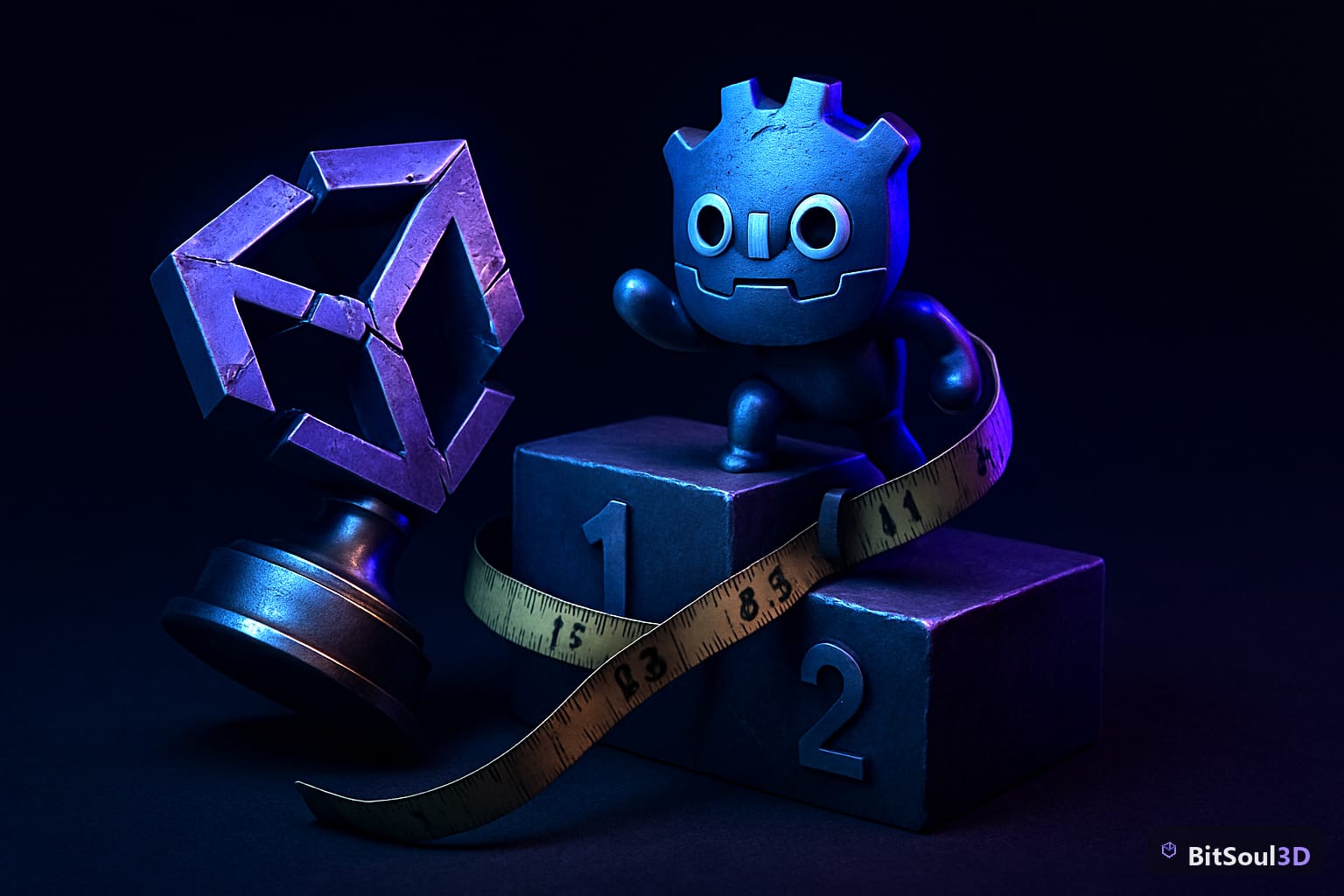
For anyone bringing GLB assets into a jam project, the reason behind the jump matters more than the headline number: it's a web export problem, and it changes which import gotchas you'll hit.
The five-year trend, not a one-off
| Year | Godot share | Unity share |
|---|---|---|
| 2022 | 16% | majority (exact % not published) |
| 2023 | 19% | majority (exact % not published) |
| 2024 | 37% | 36% |
| 2025 | 39% | ~40% |
| 2026 | 47% | 34% |
The 2024 crossover lines up with Unity's Runtime Fee announcement and reversal that same year, which is when a lot of jam regulars started trying Godot as a hedge. What's notable about 2026 is that the gap widened again after 2025's near-tie — this isn't teams drifting back once the fee scare faded.
Why web export size is the actual driver
Jam games get uploaded to itch.io and played in-browser within hours of the deadline, so build size and boot time aren't cosmetic — they're the difference between a rater actually loading your game or bouncing. A minimal 2D scene exported from Godot 4.6.2 as WebAssembly comes out around 3.5 MB. The same scene from Unity 6.4's WebGL export lands near 11 MB — a 3.1x difference. Godot 4.7, which shipped in June 2026, made this gap worse for Unity by turning on WebAssembly SIMD by default and adding a wasm64 export option, both of which cut load time further without touching your project's code.
None of that is about GDScript versus C#, or editor preference. It's a distribution constraint that compounds under a 48-72 hour deadline, and it's why the jam numbers moved.
What actually breaks when you drop a GLB into Godot
If you're pulling game-ready models into a fresh Godot project mid-jam, three things trip people up every time:
Textures embedded in the GLB get extracted as separate PNG files on import — Godot doesn't keep them packed the way Unity's importer does, so a model that looked self-contained now has a handful of loose texture files sitting next to the .import metadata. That's fine until you move the folder and the references break.
Metallic-roughness data doesn't always survive round-trips cleanly, particularly on assets re-exported from Blender 4.2 or earlier — you'll see materials come in flat gray instead of textured. Checking the material slots in the Godot inspector immediately after import, before you touch anything else, catches this in seconds instead of after you've built half a level on top of it.
Re-importing an updated GLB doesn't always pick up the change — Godot can hold onto the cached version, so if you're iterating on a model mid-jam, deleting the .import file for that asset forces a clean re-read.
None of these are Godot bugs exactly — they're friction points from Godot's import pipeline being newer and less battle-tested than Unity's, which has had a decade longer to sand off edge cases. Our Godot 4.8 dev-build coverage goes deeper on what's changed in the scene format itself if you're tracking dev builds ahead of the 4.8 release candidate.
The prototyping-speed table
| Task | Godot 4.7+ | Unity 6.4 |
|---|---|---|
| Minimal WebGL/WASM export size | ~3.5 MB | ~11 MB |
| WASM SIMD | On by default | Requires manual config |
| GLB texture handling | Extracted to loose PNGs | Kept packed |
| Material round-trip from Blender GLB | Occasional flat-gray on re-import | Generally stable |
If you're greyboxing a level fast, a modular kit like Corridor Module imports cleanly into either engine and is a reasonable way to test your pipeline before committing real jam hours to it — check the inspector materials the moment it lands, per the gotcha above.
If your textures are large enough to matter for the 3.5 MB budget, compressing to KTX2 before export is worth doing ahead of the jam rather than mid-crunch; we covered which engines actually load it correctly in our KTX2 breakdown.
A free BitSoul account's two monthly downloads cover this kind of evaluation and prototyping; commercial use of any shipped jam game that goes further is included with paid memberships — see pricing.
Godot's numbers keep climbing because the web export math keeps getting more lopsided, not because of a single feature release. If your next jam project is browser-first, that's the variable to plan around before you pick an engine.
This post is part of the Ultimate Guide to Free 3D Game Assets — BitSoul's complete reference for formats, texturing, rigging, optimization, and engine integration.
Need drop-in assets for this workflow? Grab the 94-model Animal Bundle on the BitSoul marketplace and drop them straight into your project.